|
15th August |
|
|
|
     
LoN news up to 13th August 2010
We have now just passed the half way stage of this season’s excavations at Noltland- and there have been several new discoveries and some excitements to relate.
Our excavation team has increased in size with the arrival of Emily and Val and the return of Dawn. Dawn and Emily have been working on a Roman - Byzantine period site in Albania for the past month. They are slowly adjusting to our slightly cooler conditions but are nevertheless taking every opportunity to show off their deep Mediterranean tans!
We are working on three main fronts at the moment- excavating the interior of Structure 9 and continuing to lift cattle skulls from its wall core, extending our trench to the south and east to find the limits of the Structure 8 complex and, finally, we are recording and removing a series of late features and deposits built over Structure 8. Sean is excavating a sondage to investigate a deep sequence of midden deposits which built up to the outside of the Structure 8 complex.
We have been recovering large concentrations of animal bone over the past weeks, together with increasing amounts of well preserved pottery. Star finds this week have included a polished stone axe (from the old ground surface to the south of Structure 8), a basal pot fragment with ‘lattice’ decoration on its inner surface, a (slightly lumpen) carved stone ball and numerous bone and stone tools, including several fine and complete dress pins.
Site visitor numbers are still high- with 10 or more group and individual visits, on average, per day. This may not seems like a lot but we are delighted that so many people have made it out to what is, after all, a fairly remote location. We try to provide site tours to as many people as possible but this is taking up an increasing amount of time and, unfortunately, we may have to rethink our policy. If you fancy a trip out- please do come along but be aware that we are busy, that we have lunch between 1 and 2 pm and that are unable to take tours after 4.00 pm (to allow ourselves time to pack up for 5.00 pm).
Over the past few days we have had visits from an illustrious array of folk- including a Norwegian civic dignitary, Rolf Hestness and his wife in the company of OIC convener Stephan Hagan and his wife, archaeologists Colin Richards, Mark Edmonds, Jen Harland, Caroline Wickham-Jones, Jane Downes (Orkney College), Julie Gibson (County Archaeologist) and geologist Scott Pike. Colin Richards wrote most interestingly of his visit and his impressions of the site in the Orcadian newspaper. It is great to have the opportunity to discuss the site with so many experts and to get some feedback whilst we are still in the field.
The coming week promises to be exciting- with the excavation of internal floors and the entrance passage to Structure 8 in prospect. Digging for Britain starts this week too (Thursday 9.00, BBC2) and Noltland should feature early in the series. We also have visits planned from National Geographic and University of Glasgow dating expert, Dr. David Sandison. Watch this space ! |
|
|
Wednesday 4th August |
|
|
|

This week has seen the excavation of midden spreads covering the east side of the site in the extension. The middens are extremely rich and contain large amounts of grooved ware pottery, bone, worked bone, flint and stone tools. Maeve and Alexis have been excavating a dense spread of butchered bone and stone tools- no easy task since each fragment and tool must be separately drawn and numbered. Maeve’s plan is a work of art! Work is also continuing to record and lift the cattle skulls from amongst the wall of Structure 9. Sheena provides a rundown on this:
Hi, my name is Sheena Fraser and I will be examining the animal bones recovered from the Links of Noltland site. I have been on site for the last two weeks, my second visit this season. 
 There have been thirty cattle skulls recovered in the east and west wall cores of Structure 9. They were packed into the base of the wall core, sometimes with their horns intertwined. Apart from two skulls, all have been deposited on their dorsal surface (face down). The skulls have been crushed by the inclusion of stones in the wall core and by the weight of material placed above them. They may also have been damaged by later ploughing. The bones remaining varies from skull to skull, but all include horn cores. There is a range in the size and shape of these horn cores but some are large and in the upper area of a graph compiled by the archaeozoologist Caroline Grigson for basal circumference plotted against length of outer curvature for British and European male Neolithic cattle. The project conservator (Pieta Greaves, AOC) has lifted five cattle skulls already, after pre-treatment (see previous blog).

The midden area currently under excavation further to the east of Structure 9 with the cattle skulls has produced large quantities of bone in good condition, but fragile. The distribution of bones is not homogenous and some areas seem to be particularly dense in bone material. The bone finds include a large number of sheep and cattle lower jaws. We have just uncovered a section of articulated cattle vertebrae. When these bones are fully excavated they may give some insight to butchery practices employed by the Neolithic people at Links of Noltland.
|
|
Thursday 29th |
|
|
|
   
The past week has seen us extending our main excavation trench to include the whole area of Structure 8. This building, which we started to uncover in 2009, is thought to have been a large ‘farmhouse’ which was occupied over a long period. Extending the trench has meant removing the substantial spreads of midden which cover the structural remains and we have been kept very busy recording and lifting finds from these deposits. The middens are packed with domestic waste such as bone and shell and also with manufactured objects such as bone tools, beads, bone working waste, flint, pottery and stone tools. The bone is in excellent condition and even the pottery, which can be poorly preserved closer to the surface, is here surviving well. A lot of the recently discovered pottery is decorated and several novel motifs have been spotted.
Several features of particular interest have come to light during the excavation of the middens.
There have been a number of findings of human bone fragments from amongst these deposits. Our on-site osteologists (Maeve and Mairead) estimate that several individuals are represented, with both child and adult remains present. The bone is fragmented and scattered and not apparently coming from, for example, disturbed burials. It is securely stratified within the Neolithic levels, however, and cannot be intrusive. We are now scanning our bone assemblage to check for the presence of further human remains.
Equally interesting has been the discovery of spreads of animal bone on the midden, containing deliberately placed and carefully composed elements. In one instance (expertly identified by Dan) twenty or so animal jaw bones were arranged in a dense formation with, in several cases, rib bones placed in close association. In another (discovered by Sean) a pair of cattle horn cores were positioned with a scallop shell between them; the shell containing a worked flint. A cache of unworked cattle phalanges and another of manufactured bone mattocks were found nearby. Meanwhile sisters Hazel and Alexis have discovered a further spread of densely packed animal bone amongst which a near complete cattle skull and numerous skaill knives and unworked beach pebbles are arranged. The area is still being uncovered and as yet were do not know how extensive these remains may be. It is apparent that they represent more than random discarding of waste material, however, although it is possible that they form part of a butchery surface. It is certain that the ‘middens’ here were not merely rubbish heaps but rather they formed a focus for a range of activities, amongst which butchery, craft working and acts of structured deposition were included.
At Structure 9 (the cattle skull building) Sheena has been preparing the skulls for lifting by conservator Pieta Greaves (from AOC Scotland). The total number of skulls now identified stands at 30- if the full circuit of the walls had survived there may have been 40 or more skulls originally. Pieta is using a new technique which she has described below:
This week I will be lifting some of the cow skulls. The conditions of the skulls are poor, all are fragmentary and many are crumbling with soils surrounding the skull fragments. Complicating this is the fact that several of the skulls have horns that either interlock or cross over one another.
The skulls are too fragile to be removed on their own so I am applying a special wax called cyclododecane. To apply the wax I firstly heat it up on a little camping stone then I paint it onto the surface of the skulls, it forms a hard outer shell which provides enough extra strength to the skulls that I can then lift them out of the ground. So far I have managed to remove one skull successfully and I am currently working on the next.
Once all the selected skulls are out of the ground the skulls will be taken down to Edinburgh for further conservation, however the wax will not have to be removed as in a few weeks the wax will evaporate off, leaving just the cow skulls to be cleaned up ready for future study and possible display.
?
?
|
|
Tuesday 20th |
|
|
|
  we have been busy cleaning the site today - a crack team from Historic Scotland are due on site tomorrow to carry out some laser scanning - this promises to be very exciting and should give us very accurate images so more on this anon.
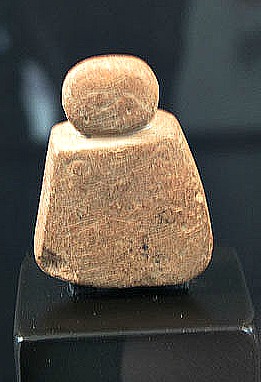
The big news for now is the second figurine, which came up a couple of weeks ago but we were unable to mention it before now due to a press embargo. This one is made of pottery and is the same size as the first one, so quite small. There are incised lines on one side - see the picture on the front page of the westray heritage site. It is missing a head but the marks where one was attached are visible - we think a small clay ball, not unlike some of the ones we have been finding, would have fitted here. I have posted two pics of Sean holding it ( yes, Sean found it). Sean was thrilled to find it and its a credit to his skills that he recovered both the main piece and another smaller one which had broken off it in antiquity
|
|
Monday 19th |
|
|
|

Lots of news just now, what with the new figurine and the British Archaeology Awards bash at the British Museum today - the figurine was up for 'best find of the last year' but was in the end sadly pipped to the post by the Staffordshire Hoard. More pics to follow (cant download the camera for some reason) but in the meantime, our very own Mairead has penned this...so take ita away Mairead!
Hi all! A lot has been happening down the Links since the last blog. Things are looking great at the moment in the Cow Skull House. The rubble has been removed so now the archaeology has become a lot clearer. Hazel and Dan have been working hard and have uncovered the hearth together with some burnt whale bone and pot, and in the past couple of days Dan has found two really nice beads and another cow skull which will keep Sheena very busy!
Sean has been working hard removing a couple more spits from the midden and has come up with some really nice finds, amongst them: two bone points, decorated pot, and his absolute favourite; coprolites! Needless to say Sean’s taste test is still working a treat. We’ve had lots of visitors to the site in the past couple of weeks also, and our roving reporter Maeve has valiantly been fielding lots of questions from inquisitive visitors. Last Friday saw us rained off site late in the afternoon, but not before Maeve temporarily lost the will to live and painted her face with some homemade war-paint! Luckily Graeme got a picture before it washed off. The mud also tried to take Andy out while he was 3D-ing finds, and with a very graceful slow-motion fall he managed to save the prism from an un-timely death.
Our lunchtimes have also become very entertaining. Last week our very own Evil Knievel (Andy) launched himself over the fence and landed on the other side without a scratch. We also had a scary moment when Alexis braved a nearby herd of cows to tell them off for letting their calves eat some black plastic bags. Today she showed us her impressions of various bog bodies and mummies. Some of the favourites were Ramses II and Otzi. She also did a surprisingly vivid re-enactment of a limpet being attacked by a dog whelk. She has promised us that once her sister Hazel arrives there will be more mummy and bog body impressions to keep up morale.
Two new members have also joined the team since the last update. Russell Henshaw, who today painstakingly excavated eight tiny beads made from tooth roots which is a really rare find! And today we were joined by John Nove from Massachusetts, who is going to volunteer with us a few days of the week for the season. Hopefully some more nice finds will pop up in the next few days, along with a few new arrivals to the team so we will keep ye posted! |
|
|
|
|
<< Start < Prev 1 2 3 4 5 6 7 8 9 Next > End >>
|
|
Page 1 of 9 |